Librarians shape and inspire their community
By Jeanne Davant
Throughout Pikes Peak Library District (PPLD), librarians work hard to serve Library patrons. Their impact on the community goes far beyond helping a Library user check out a book or answering a reference question.
It has been said that libraries are magical places and Library staff bring that magic to life.
Librarians are able to work that magic because they are highly skilled professionals who specialize in connecting people within and outside their libraries with information and resources. They must be technological experts and educators, teaching people how to navigate today’s digital world. They oversee collections and direct the specialized programs that distinguish libraries today, such as makerspaces and recording studios, and reach out into the community to support other organizations.
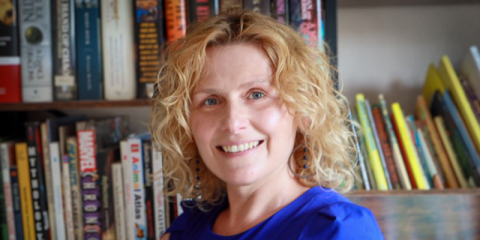
“We do a little bit of everything,” says Jennifer Luebbert, manager of Library 21c.
On a given day, Luebbert might lead a tour of the Library for a community organization, talk with a news reporter about what the Library has to offer, or speak at a community meeting.
"Librarians bring formidable skills to their jobs, but what makes the magic is their passion for what they do."
“One of my favorite things to do is just walk through the Library and see all of the different ways the community is interacting with the Library,” she says. That might be a business owner recording a podcast or an ad in the studio space, a patron transferring VHS tapes to a digital format in the makerspace, or a homeschooling group and their kids working in one of the Library’s reservable meeting rooms.
“I really see how they’re making a difference in the lives of patrons,” she says.
Luebbert graduated summa cum laude with a degree in history from the University of North Florida but didn’t want to pursue a career as a teacher. So, she enrolled in the University of Texas at Austin where she received a master’s degree in library and information science.
Luebbert first joined PPLD as a public services assistant at Monument Library, and in late 2016, she took a position as teen librarian at Library 21c. After she and her Navy officer husband moved to San Diego, she worked as programs and acquisitions librarian for the U.S. Marine Corps Recruit Depot. When they returned to Colorado Springs in 2021, she became director at the Peterson Space Force Base library before rejoining PPLD in May 2024.

Jordan Romero, PPLD’s young adult senior librarian, connects students and teachers with Library resources every day. She spent a recent morning at Harrison High School showing 10th graders how to use the Library’s databases and their PowerPass library cards (a just-for-students library card at participating school districts). She is often called upon to delve into issues like evaluating sources and statements on social media, and the increasing use of AI.
“Schools don’t have as many resources as they’d like,” she says. “The Library is a great way to connect students with resources they might not be able to afford.”
Romero started as a part-time shelver at Sand Creek Library and a year and a half later, became that location’s children’s specialist.
“I had an art degree, but I didn’t really know what I wanted to do,” she says. “I just fell in love with libraries and working with the community. It was the first time I ever felt a calling.”
While working full-time, Romero started taking classes at the University of Arizona Online, completing her master of arts in library and information science in 2023. She began working with ninth grade through post-secondary students as a school engagement librarian in July 2025.
Skills and knowledge
Librarians work in a variety of settings, most commonly in public, school, and academic libraries, and independent, tax-supported districts like PPLD. Specialized librarians are also employed by federal and state governments, museums and historical sites, hospitals, performing arts companies, and scientific research and development services. Digital librarians specialize in electronic resources, digital archives, and online access for web search portals and other information services.
The District's librarians work under basic principles that have been established to protect the rights of its patrons and to optimize service. PPLD's Rights and Responsibilities are listed below:
- PPLD understands its obligations under all local, state, and federal laws that govern library operations.
- PPLD seeks to provide free and equal access to basic library resources as outlined in PPLD’s lending and circulation policies.
- PPLD commits to being open and accessible to the public no fewer than 20 hours per week in compliance with Colorado law.
- PPLD works to ensure patrons are not prevented by PPLD from accessing library materials or programs on the basis of race, sex, religion, or any other status protected by law.
- PPLD reserves the right to catalog materials by category, topic, age, reading level, or other standard cataloging metrics.
- PPLD agrees to adopt technology protection measures to enforce Internet safety for minors, while acknowledging guardians’ rights to supervise and monitor their minors’ access to materials or programs.
- PPLD aims to protect patrons’ privacy and safeguard library use data in accordance with the law.
- PPLD endeavors to remain a nonpartisan, neutral entity, and its goal is to provide materials and information representing all viewpoints on current and historical matters.
- PPLD patrons are responsible for complying with PPLD policies regarding their conduct and use of library resources, as well as local, state, and federal law while on library premises.
- PPLD patrons are responsible for respecting the rights of others using library services, including the right to access and use library resources.
- PPLD retains the right to enforce PPLD policies to achieve its mission and maintain a safe environment for its patrons and staff.
“Librarians bring formidable skills to their jobs,” Romero says, “but what makes the magic is their passion for what they do.”
“You can learn how to manage information and how to direct people to resources,” she continues. “But the one thing you can’t really learn is to have a heart for people and really want to make life better for others.”