
History of the Mobile Library Services
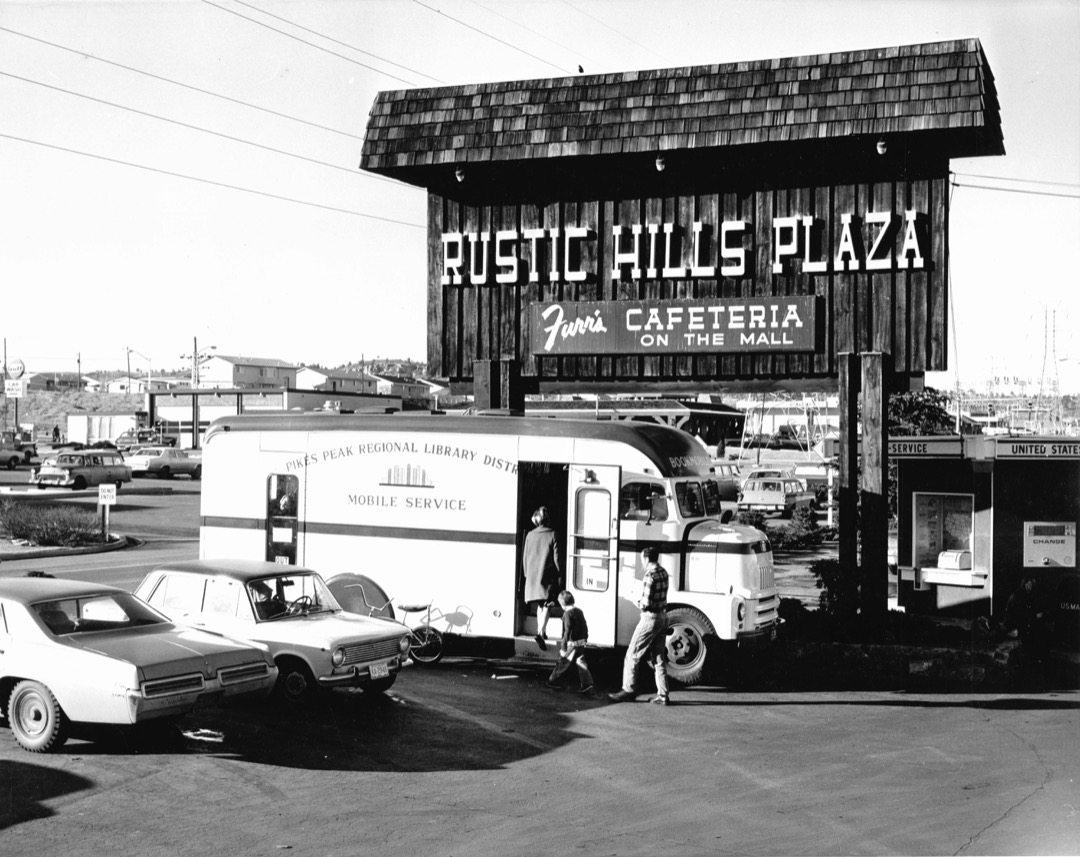 On May 28, 1953, Head Librarian Margaret Reid presented to the Board of Trustees a three-part plan that would set in motion both Mobile Library Services in the Pikes Peak region and the county-wide library system that would later become Pikes Peak Library District (PPLD). The plan called for the Colorado Springs Public Library to launch a bookmobile, construct a new central library, and ultimately expand mobile services throughout El Paso County. The first step took shape in 1954, when a Bemis-Taylor Foundation grant allowed the Library to purchase and launch its first bookmobile. Almost immediately after the service began, the Colorado Springs City Council announced it would not fund its continued operation. Representatives of the foundation, concerned that their support might be wasted, questioned whether the Library intended to operate the service at all. Reid responded with a bold proposal: run the Library on a reduced operating budget and reserve funds to fully launch and sustain bookmobile service. All parties agreed.
The bookmobile was an immediate success, circulating more items than the Westside Library in its first year of operation and then doubling that number again in 1956. Building on that momentum, the Library pursued two major electoral goals to secure sustainable funding and expand services across the region. In 1961, voters approved removing the Library from the city's charter, allowing it to receive property-tax funding directly. In 1962, county residents approved expanding Colorado Springs Public Library into a regional district. The new Pikes Peak Regional Library District formally began operation on January 1, 1964.
In its first year, the new district purchased two additional bookmobiles, bringing the fleet to three. Services expanded rapidly, but the growth came with challenges. The District still lacked a proper garage, and the vehicles were parked outside, including at the County Poor Farm near 21st and Rio Grande, where storage conditions caused maintenance issues and occasional vandalism. The opening of Penrose Library in 1968, made possible by a surprise $2.2 million grant from the El Pomar Foundation, finally resolved the problem by providing a dedicated garage (and the new central library envisioned in the 1953 plan). By the time Reid retired in 1974, several high-demand bookmobile stops had already led to, or were in the process of becoming, full PPLD libraries—the East Branch (now Ruth Holley Library), the Broadmarket Square Branch (now Cheyenne Mountain Library), and the Fountain Library.
From 1975 onward, Mobile Library Services continued to evolve as aging vehicles were retired and replaced. The Kidsmobile debuted that year, created by converting an older bookmobile into a children’s outreach vehicle that remained in service until 1989. A new vehicle entered service in 1980, and in 1981 it was equipped with an onboard microcomputer—an early step toward integrating technology into mobile operations. Another new vehicle was launched in 1989 and soon received data radios that provided real-time access to the Library’s catalog. The fleet continued to modernize with a new bookmobile placed into service in 1998, followed by a replacement launched in 2006 and another new model introduced in 2008. Existing vehicles also received technology upgrades over the years, including the addition of satellite dishes in 2004, which for a few years became a prominent visual feature of the mobile fleet.
The Falcon stop illustrated a familiar pattern in Mobile Library Services: high-demand stops often grew into full Library locations. The community in Falcon had long been one of the busiest mobile stops in the eastern part of the county, and its rapid growth pushed the mobile fleet to its limits; at times, staff sent a second vehicle solely to manage holds and returns. When the replacement bookmobile arrived in 2006, the retiring vehicle was parked permanently rather than sold, and it was placed in Falcon—a possibility the District noted as one way to address the area’s growing demand, though it ultimately chose not to activate it as a permanent library. Instead, as usage continued to climb, the District committed to constructing a permanent facility. High Prairie Library opened in 2010, with the final bookmobile stop in Falcon occurring on October 14 of that year—a moment one PPLD report described as “historic,” bringing a decade of mobile service in the community to a close.
Even as new Library locations opened across El Paso County, Mobile Library Services continued to meet growing demand throughout the region, providing direct access to Library materials and resources for communities where flexible, mobile service remained essential. To support this ongoing mission, the District added its newest bookmobile—a Freightliner MT55 placed into service in late 2025—equipped with updated technology and expanded capacity to reach patrons wherever they are, ensuring that Mobile Library Services remain a core component of Pikes Peak Library District and continue the commitment first outlined by Margaret Reid in 1953 to bring Library service directly to people across the region as technologies, communities, and needs evolve.