
History of Monument Library
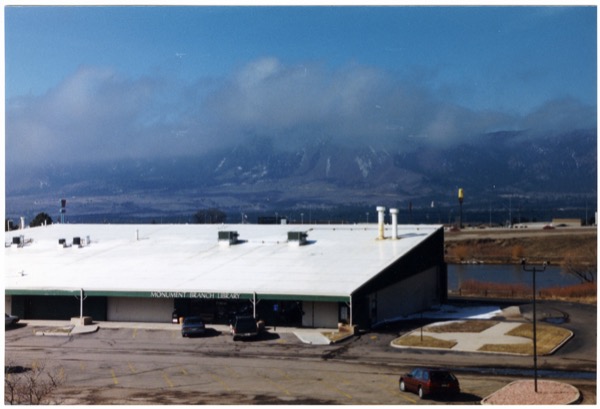 Monument Library has served the Tri-Lakes region for nearly 50 years, growing alongside the communities of Monument, Woodmoor, and Palmer Lake.
The story of the Library’s surroundings begins long before the building itself. In 1871, William Jackson Palmer extended the Denver & Rio Grande Railway through the area, creating a corridor of development that led to the early growth of Monument. As settlement spread along the rail line, new residents claimed nearby land and established ranches, small businesses, and homes.
One of those settlers was Herman Schwanbeck, a German immigrant whose name survives in Mount Herman. Although often described as a homesteader, Schwanbeck obtained his land through federal land scrip—a transferable land credit that allowed him to invest in property after the railroad opened the Palmer Divide to new settlement. His 160-acre parcel encompassed the land that today includes the Woodmoor Center, Monument Library, and Serenity Pond.
The surrounding area changed dramatically decades after Schwanbeck’s time. Work on the Woodmoor Lake dam and reservoir began in the late 1960s, creating a manmade lake originally supplied by a gravity-fed pipeline from Dirty Woman Creek. Serenity Pond near the modern Library site was constructed as part of the same engineered water system, developed during the early suburban growth of the Woodmoor area.
As the wider Tri-Lakes region continued to expand in the 1970s, residents sought a library that could better serve the growing population. Lewis-Palmer Middle School offered a room with its own outside entrance, and on April 5, 1975, Pikes Peak Library District opened Monument Hill Branch Library in that space. By the end of 1978, however, rising enrollment meant the school needed the room back, and the Library needed to find a new home.
After voters approved an increase in the Library District’s mill levy, the Monument Library moved to a small, rented space in what was then known as the Mine Shopping Center, now known as Woodmoor Center. As the region continued to grow, the Library shifted and expanded several times within the same complex: first into an adjacent space in 1987, and then into a significantly larger 5,400-square-foot location in 1998. In 1999, the Library officially shortened its name to Monument Branch and celebrated a grand reopening on June 19. A final expansion followed, reopening on Feb. 22, 2003, with the “Check Out Our Roots” celebration, completing its transformation into the large, full-service location that serves the community today.
By the 2000s, Monument Library had become one of PPLD’s busiest and most visible locations. As the executive director reported to the Board, nearly 2,000 people visited the Library the day after Memorial Day in 2008, contributing to what was then the District’s record for single-day patronage. That same year—just a few years after the location reached its modern scale—Monument was named Colorado Library of the Year, the only individual PPLD location ever to receive that honor. Pikes Peak Library District as a whole received the award in 2014.
From its beginnings in a single schoolroom to its multiple expansions in the Woodmoor Center, Monument Library has grown in step with the community that surrounds it, shaped by the landscape, the railroad that opened the region, and generations of Tri-Lakes residents who continue to rely on it. Today, it is known for its focus on children’s services and programming—and for the ducks that regularly gather at Serenity Pond, a feature associated with this Library location. Monument Library plays a central role in the civic and cultural life of the Tri-Lakes area.