
History of Penrose Library
Penrose Library stands at the heart of Pikes Peak Library District (PPLD), a facility shaped by philanthropy, rapid regional growth, and decades of technological change. This location shares space with the original Carnegie library building made possible in 1905 by funds from a foundation started by philanthropist Andrew Carnegie.
In 1964, with PPLD newly founded as an expansion of the Colorado Springs Public Library to serve most of El Paso County, the District had finally realized one of its primary goals: securing the resources to project library service well beyond the city limits through a fully funded mobile services division. Yet one challenge emerged immediately. The 1905 Carnegie library downtown—long the center of library activity—could not meet the needs of a rapidly growing metropolitan area.
A major constraint lay in the land itself. The parcel had been donated by William Jackson Palmer with a strict stipulation: if it ever ceased to be used for library purposes, it must revert to the Colorado Springs Company. As a result, the District could not sell, lease, or transfer the property to help finance a much larger facility. Achieving a new main library would require an entirely different solution.
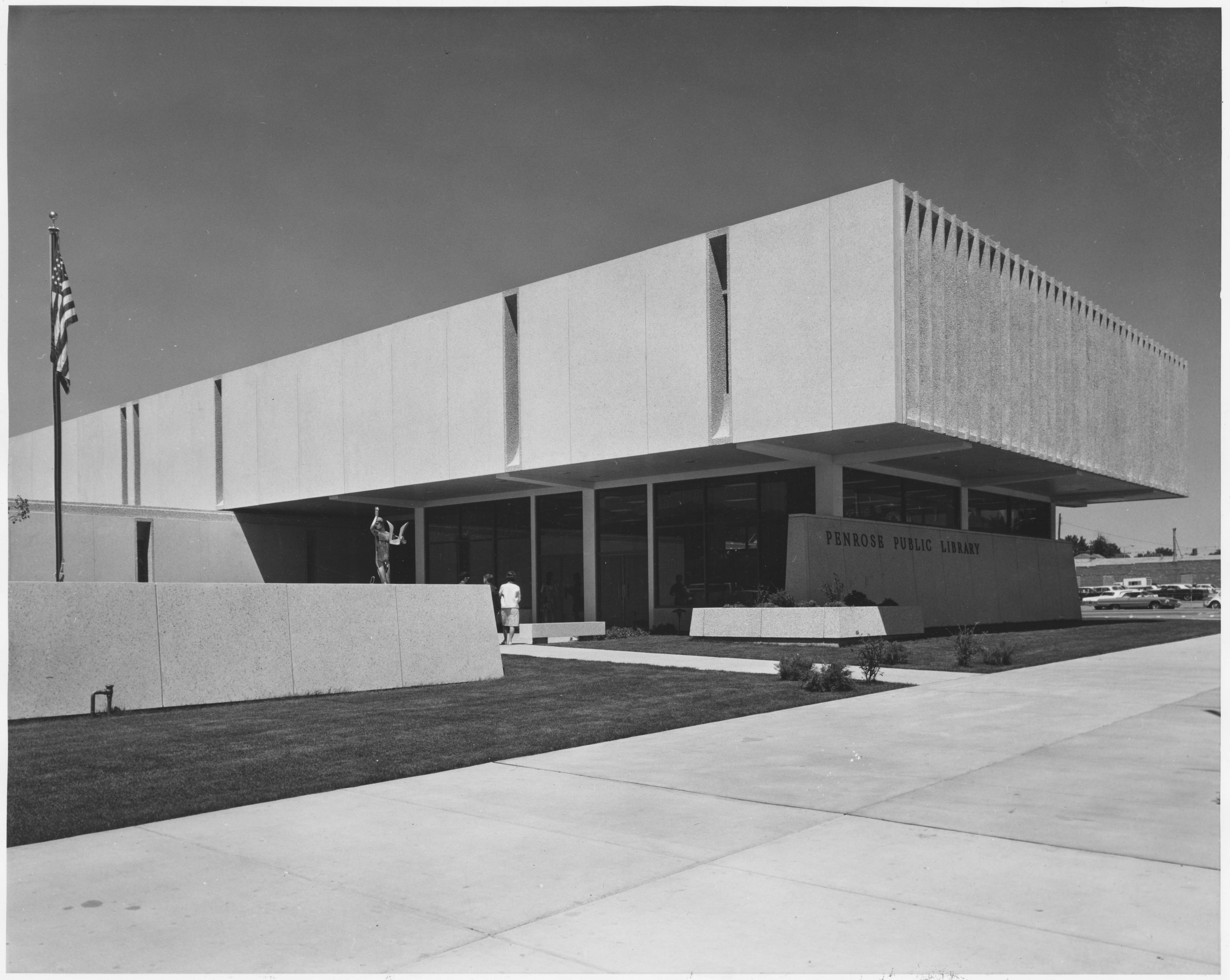
That solution arrived suddenly on February 12, 1966 when H. Chase Stone convened the PPLD Board of Trustees along with city and county officials to announce an extraordinary gift from the El Pomar Foundation: $2.2 million for the construction of a new main library, to be known as Penrose Public Library in honor of the foundation’s original donors, Spencer and Julie Penrose. With the grant, El Pomar purchased the adjacent Marksheffel Garage, which would be demolished and replaced by a modern library building physically connected to the 1905 Carnegie. This ensured the Carnegie building continued operating as a library, fully honoring Palmer’s deed.
Penrose Library opened to significant public celebration in July 1968. With the long-awaited main library finally complete, Head Librarian Margaret Reid—who had guided the transformation of the Colorado Springs Library since 1948—immediately turned her attention to preparing Penrose Library for the emerging information age. After a few preliminary attempts to introduce automation, Reid retired in 1974 and helped the Board of Trustees recruit a director with a clear technological vision: Kenneth Dowlin.
Dowlin arrived with a four-phase plan to “computerize the library.” Initially he brought circulation online using the county government’s mainframe through a system later known as Maggie, but by 1977 PPLD installed its own computer—a Digital PDP-11/70, dubbed Maggie II—in the Penrose Library basement. By the spring of 1978, Penrose Library was fully off the county system. Over the next decade, Penrose Library evolved into a local hub of early library technology, connecting patrons to the online catalog, databases, the federally funded RideFinders service, and other library systems nationwide. National studies of emerging library automation regularly cited PPLD as an example, and Dowlin chronicled the work in his influential 1984 book The Electronic Library. Although the system later moved to East Library as Maggie III in 1987—and Dowlin himself departed for San Francisco that same year—this era became a memorable chapter in Penrose Library’s development.
By the early 1990s, Penrose Library faced familiar challenges: limited parking and the need to adapt to other aspects of its downtown environment. The District addressed these with a series of modifications to once again modernize the location.
In 1992, the El Pomar Foundation transferred the aging Antlers Garage to PPLD with the expectation that it would support patron parking. Years of planning and financial maneuvering followed. At one point, PPLD sold and later repurchased the garage, culminating in the garage’s demolition and replacement with a surface lot while preserving its historic façade along Pikes Peak Avenue.
In the late 1990s Penrose Library underwent a major renovation, which added a lower parking area, introduced west-facing window bays to take advantage of newly opened mountain views, reconfigured public spaces, relocated the children’s area to the main floor, and expanded the basement into a full lower level with a computer lab. As these improvements took shape, Penrose Library also broadened its role as a center for research services: the adjacent Carnegie Library was transformed into the home of Regional History & Genealogy, and the Law Library—with access to Westlaw—relocated to the building’s lower level in 2002.
As a downtown library facing unique space, infrastructure, and security pressures, Penrose Library has enacted many improvement projects in recent years. Work has included the addition and reconfiguration of meeting spaces on the lower level, further modifications to the children’s area to establish its own enclosed area, renovations to the computer lab and the installation of a perimeter fence to better define and protect the complex. Together, these changes reflect Penrose Library’s ongoing adaptation to the needs of a growing city while continuing to serve as a central hub for public library service in Colorado Springs.