
History of East Library
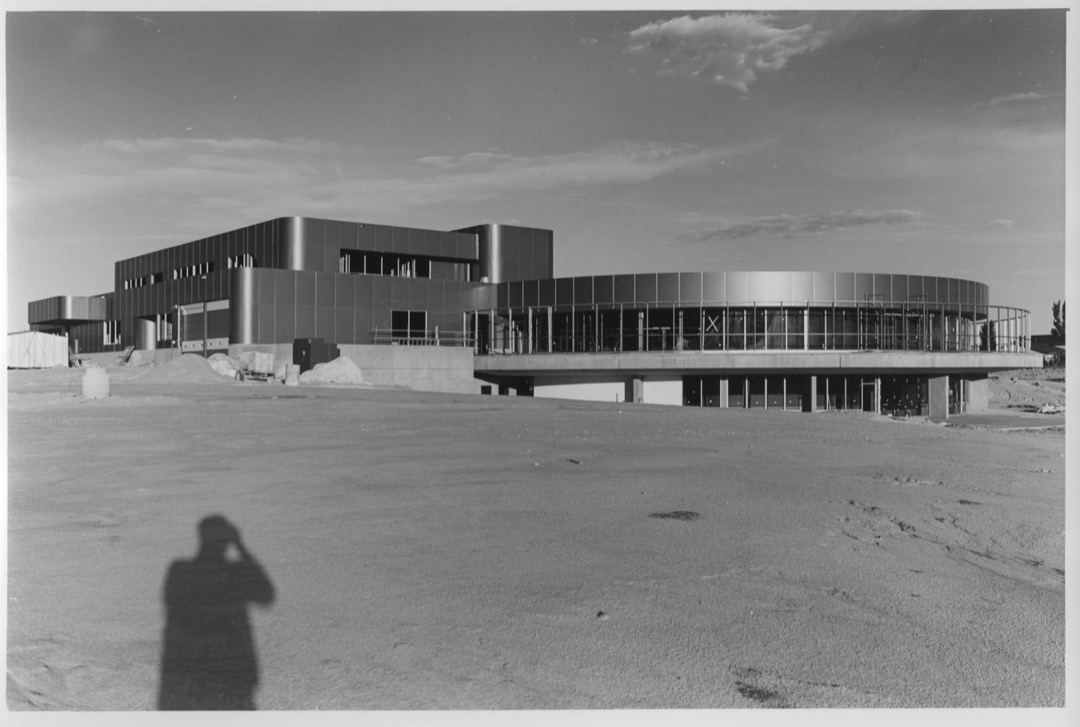
Located just east of Templeton Gap—the natural passage through the Austin Bluffs long used by Ute people—East Library stands at a crossroads where regional growth, civic planning, and library service converge. Its creation reflects the extraordinary expansion of Colorado Springs in the postwar decades. After the establishment of major military installations including Fort Carson, NORAD, and the U.S. Air Force Academy, the city’s population rose from 45,472 in 1950 to 215,105 by 1980, reshaping the scale and expectations of public services throughout the region.
Pikes Peak Library District (PPLD) first served the rapidly developing northeast side of the city through bookmobile service beginning in the 1960s, including regular stops at Rustic Hills Shopping Center. By 1972, after surveying potential locations at several shopping centers, Rustic Hills was identified as the best site for a storefront library due to its proximity to growing residential neighborhoods. The resulting East Branch, which operated in three Rustic Hills locations between 1973 and 1986, quickly became one of the District’s busiest outlets, and by the late 1970s, expanding service in the eastern area of Colorado Springs had become a top priority for the Board of Trustees.
A turning point arrived with the District’s 1983 Facilities Study, which concluded that PPLD needed a second main library to pair with Penrose Library downtown. The report identified the northeast as the region of greatest need and even recommended the very site where East Library would ultimately be built: a parcel of undeveloped School District 11 land near Union and Academy Boulevards. That same year, voters approved a $9.9 million bond issue, providing the capital needed to construct East Library as well as what would later become Sand Creek Library.
With the site cleared for purchase in late 1983, PPLD selected Muir & Associates to design the new building. Their plans paid deliberate tribute to the 1905 Carnegie library downtown; East Library’s large central rotunda was conceived as a modern and expanded echo of the Carnegie Reading Room. Construction was awarded in 1985, and groundbreaking took place on August 27 of that year.
Even as construction progressed, PPLD still faced a challenge: Colorado law limited library districts to a 2-mill levy, which was not enough to operate the new facility at full capacity. Working alongside library districts across Colorado, PPLD participated in a statewide effort supporting legislation that allowed libraries to seek up to 4 mills. Once the law passed, the Board placed a mill levy increase on the November 1986 ballot, and Director Kenneth Dowlin personally led the campaign. Voters approved the measure, ensuring that East Library could open fully staffed when construction concluded.
On Jan. 10, 1987, after more than a decade of planning, the East Library and Information Center—quickly nicknamed ELIC—opened to the public. It immediately became the District’s busiest Library, a status it has retained every year since. From the beginning, East Library also housed districtwide support functions, the Friends of the PPLD Bookstore, the PPLD Video Center—which produced award-winning content for “The Library Channel”—and a Motor Vehicle Registration office that remained in the building until 1999. After the DMV’s departure, the vacated space was transformed into a large and award-winning Teen Center, which opened in 2007.
Growth continued unabated. In 2008, the day after Memorial Day, East Library set a new District record when nearly 5,000 people visited the building in a single day. Continued increases in demand eventually led to the development of the Tri-Building Project following the District’s 2012 purchase of what would become Library 21c. The reorganization of library services across East and Penrose libraries, as well as Library 21c, allowed several support departments and creative services to move out of East Library, freeing additional space for public use.
Today, East Library remains PPLD’s busiest location by multiple measures and circulates more than a quarter of all materials in the District. Its Community Room continues to host major public programs, including the annual Pikes Peak Regional History Symposium.
One enduring quirk has been the Library’s name. Even in 1987, East Library was not located at the city’s far eastern edge—yet the Board of Trustees adopted the name “East Library and Information Center” directly from the working title used in the 1983 Facilities Study. Internally, the Library was routinely called “East,” “East Library,” or “ELIC.” The District’s 2002 annual report marked the first official public use of the simplified name “East Library,” and in 2005 the Board formally approved that change while adopting a new policy requiring official approval for the naming or renaming of any Library facility. The name has continued to prompt discussion in the years since, remaining a small but familiar curiosity within the District.