
History of Sand Creek Library
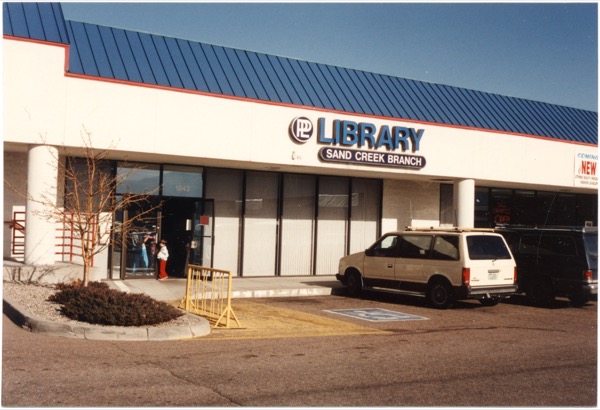 Sand Creek Library stands in southeast Colorado Springs, a suburban region that expanded significantly during the city’s population boom of the 1960s and 1970s and today is home to one of the most diverse populations in the community. The parcel beneath the Library traces back to one of the area’s earliest civic leaders, Benjamin Crowell, who arrived in 1860 as a bookbinder and quickly became active in the civic life of Colorado City (now Old Colorado City) while also operating a small farm near what is now Lake Avenue and Cheyenne Road. Crowell later struck it rich through investments in the Leadville silver mines, and by the time he signed the 1872 paperwork officially creating the municipality of Colorado Springs, he had already begun acquiring large tracts in what is now southeast Colorado Springs, including the parcel where Sand Creek Library is located today.
Although early development in Colorado Springs moved primarily to the north and northeast, southeast Colorado Springs took shape later, especially during the suburban growth of the 1970s. As these neighborhoods grew, Pikes Peak Library District (PPLD) worked to keep service balanced across the region. The District opened a neighborhood Library in the northeast as early as 1973, but comparable service in the southeast lagged behind for more than a decade. A major 1983 facilities study, the same one that led directly to the construction of East Library in 1987, identified southeast Colorado Springs as a part of the community that needed a permanent branch.
With a mill levy increase approved in 1986 and East Library and Information Center completed, the District was finally able to address the gap. On May 24, 1988, the PPLD Board of Trustees approved signing a lease for a new location in Pace Plaza and formally adopted the name Sand Creek Library. The branch opened in October 1988, becoming PPLD’s first dedicated Library service point in the southeast.
By the early 1990s, the leased space was no longer adequate to meet demand. In 1993, the El Paso County Retirement Plan arranged to purchase a larger building at 1821 South Academy Boulevard and lease part of it back to the District to house Sand Creek Library, with additional unused space available for storage. On March 29, 1994, PPLD approved a closely linked facilities decision: selling the Antlers Garage property next to Penrose Library to the Retirement Plan and using the proceeds to purchase the new Sand Creek building. The Retirement Plan would then construct a parking lot and improve elevator access for Penrose Library as part of the agreement. Sand Creek Library moved into the new space later that year, and the Library held its grand reopening on September 17, 1994.
Initially, much of the new building functioned as District storage rather than public library space. Rising community use made clear that a fuller build-out was needed, and by the late 2000s PPLD committed to transforming the entire facility for patrons. After several years of planning, Sand Creek Library reopened on March 21, 2009, with a fully renovated layout, expanded public areas, a much larger computer lab, and a new drive-up holds pickup window that became immediately popular. In the years that followed, internal reports consistently noted that computer usage at Sand Creek Library was exceptionally high—often the highest in the District—reflecting the location’s role as a major access point for digital services in southeast Colorado Springs.
In 2017, in partnership with Comcast, the District opened a makerspace and a music studio inside Sand Creek Library. The studio, now known as Studio916 in reference to the surrounding 80916 ZIP code, expanded the Library’s mission by offering creative, technical, and recording resources not previously available in the area. Today, Sand Creek Library remains a key resource for southeast Colorado Springs, rooted in more than a century of regional history that stretches back to early land investments and continuing through decades of community growth, service expansion, and innovation.