By Jeremiah Walter
As the United States celebrates its 250th anniversary and the State of Colorado turns 150 years old, the 2026 Pikes Peak Regional History Symposium will examine how our region has transformed Colorado over the years.
The event kicks off at 1 p.m. Sat., June 6, with a film festival at East Library, and continues at 1 p.m. Sat., June 13, with a series of presentations about “How the Pikes Peak Region Changed Colorado.” In-depth papers on each presentation topic will be published in the newest edition of the Pikes Peak Regional History Journal. The journal will be available on the Regional History & Genealogy section of the Library’s website, ppld.org.
Leah Davis Witherow, curator of history at the Colorado Springs Pioneers Museum, will present an underexamined aspect of the life of Colorado Springs founder William Jackson Palmer.
“She’ll look at who he was in the world of the railroad tycoons who were so prolific and influential in that era,” says John Jarrell, program coordinator for Regional History & Genealogy Department at Pikes Peak Library District (PPLD). “Palmer was an important figure in the development of the state. He was heavily involved in rail development. Without the railroad, we wouldn't be the state that we are today.”
Samantha Christiansen, associate professor of history at UCCS, will speak about the widespread responses to Colorado’s Amendment 1 (Taxpayer Bill of Rights, a.k.a. TABOR) and Amendment 2. These controversial amendments both passed in 1992 and had roots in Colorado Springs. Both amendments impacted Colorado in very different ways.
Jarrell wrote a paper that takes an in-depth look at the entire history of public libraries in the Pikes Peak region. His accompanying presentation at the Symposium will focus on the years 1949 to 1987 and former PPLD head librarians Margaret Reid and Kenneth Dowlin.
It was under Reid's leadership that Pikes Peak Regional Library District was formed. In November 1962, about 60% of local voters cast ballots in favor of the creation of the District, which included all El Paso County except for Manitou Springs and School District 3 in the Security- Widefield area. The District formally began in 1964.
“But that didn't stop Margaret Reid's growth as a library mastermind,” says Jarrell. In line with the Symposium’s theme of local influence on the state, “she worked with the state librarian to implement a fivecounty agreement under state tutelage.”
As Jarrell writes in his paper, “The arrangement provided reciprocal borrowing, centralized interlibrary loan, shared professional support, and a bookmobile dedicated to sparsely populated areas, and later became known as the Plains and Peaks System.”
In 1974, just before her retirement, “the District turned to what would become Reid’s final major institutional initiative: preparing the Library for the computerized operations. Reid argued for a system controlled directly by the Library, preserving institutional autonomy while allowing for future expansion.”
Reid was succeeded by Dowlin in January 1975, and in 1977 the Library District purchased its own computer: a PDP-11/70 from Digital Equipment Corp.
“We were then ahead of Denver in this game,” says Jarrell. “And we were, without question, one of the most influential districts in the state.”
The machine was dubbed Maggie II, and the accompanying electronic public access catalog was called Maggie’s Place.
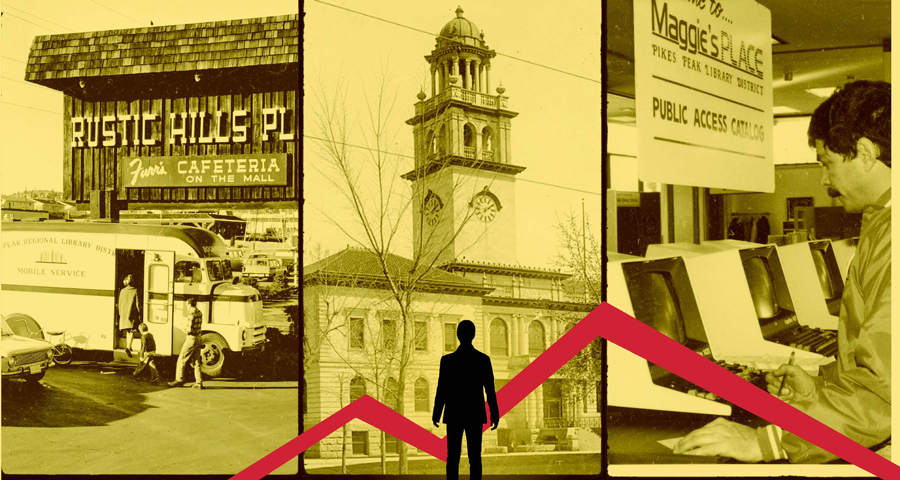
“The name reflected an in-house joke,” writes Jarrell. “The computer arrived just as an employee named Maggie O’Rourke was leaving, and when the machine was installed in her former office, Dowlin quipped that she was the only librarian actually being replaced by a computer.”
It was also under Dowlin that PPLD — which dropped the word “Regional” from its name in 1979 due to state legislation — passed a bond issue that paved the way for the opening of the East Library and Information Center in 1986. That location had its own name change, later dropping “and Information Center” from its moniker.
The new library housed Maggie III, “the District’s latest computer system,” writes Jarrell, “with dozens of terminals providing patron access in a building designed around technology from the outset.”
Visitors from Africa, Europe, Australia, South America, and Asia came to town to study the new system.
In August 1987, Dowlin left PPLD to become the city librarian in San Francisco.
“With his departure, a remarkable era closed,” writes Jarrell. “From 1949 to 1987, PPLD had been led by only two directors: Reid and Dowlin. Over those four decades, the library evolved from a municipal institution serving a small tourist city into a regional district of national and international stature — an organization that not only kept pace with Colorado Springs’ explosive growth, but helped shape the civic life of a city transformed by postwar military investment and expansion.”
PPLD has continued its legacy of remaining on the cutting edge of library service. The District went on to be among the first libraries to incorporate radio frequency identification (RFID) and makerspaces, and is now looking ahead to convert some locations to hybrid models that allow patrons additional access to Library services during unstaffed hours.
With an eye on the future, PPLD also recognizes the importance of examining our collective past through events like its annual Regional History Symposium. It can even broaden understanding of the Library District itself.
“I think that understanding how the Library functions is really important for the community,” says Jarrell. “They need to understand the history of how the Library got to where it is.”