Book Reviews by Genre: Science Fiction
Review:
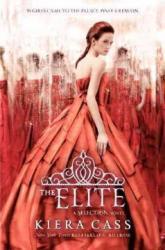
Reviewer's Name: Tierney BI love this series! Each book gets better and better as it goes on.
Although this one might not be my favorite out of all the series, it still is an amazing book. I loved every bit of it. If you read the first book you already know that there are some scenes that are more for teens and not kids, but only a few. Overall this book was so much fun to read and go through everything with the characters.
Genres:
Review:
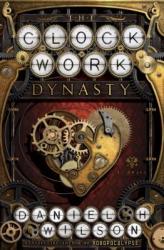
Reviewer's Name: Benjaminf there's anything Daniel H. Wilson is good at, it's writing about robots. In his latest book, The Clockwork Dynasty, he takes a steampunk approach by setting the book, not in the future, but in the present and distant past. Returning to the origins of robots via the automatons created for the entertainment of the wealthy and royal, Wilson has crafted another workable piece of fiction centered on robots. Unfortunately, as is the case with some of this other writing, I didn't like a few of his stylistic choices.
The Clockwork Dynasty jumps back and forth between flashbacks and "present era" actions, which can sometimes be distracting, especially if one of the storylines is particularly interesting at the time. I almost wonder if there could have been a better way to focus on the action in the present and to reveal the details of the past in more of a "show" instead of the "tell" provided via flashbacks. Additionally, I get why some of the violence was present in this book, but it (along with the few moments of obscenity or sex) seemed a little unnecessary.
One of my other qualms with this book was with the audiobook itself. Since the individuals reading each of the sections were different between the past and the present, it did help to know where I was in the story. However, the male voice of the past was a little quieter than the female voice of the present. This meant I turned up the volume each time the story was in a flashback, only to scramble to turn it down when the timeframe switched. Some volume leveling would have made this book a little less difficult to listen to, is all I'm saying.
A steampunk story by the modern master of robot stories, I give The Clockwork Dynasty 3.0 stars out of 5.
Awards:
Genres:
Review:
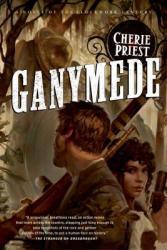
Reviewer's Name: BenjaminNow that I’ve read the first three books in the Clockwork Century series, any hope I had of some cohesive narrative is essentially gone. While following a new character for each book helps to provide a different setting of the steampunk alternate universe, when I know these characters won’t matter outside their own books, I kind of stop caring about them. Even previous heroines are relegated to cameo and minor character status as the persistent series of somewhat pointless events drags on. And don’t even get me started on the zombies, which are a distraction to any actual story in my opinion.
I think the main problem I have with these books is the fact that things happen without much lead-up or foreshadowing. Sure, there are some fascinating factors involved with making a submarine work in the Civil War era, but the resulting battle and conclusion went exactly as I expected them to. This isn’t foreshadowing as much as it is conforming to clichés. There doesn’t seem to be much at stake in any of the character arcs, which is made all the more prevalent by the relatively uninteresting characters themselves. Some have distinguishable quirks, but they all feel flat in a world that could be that much more interesting.
As for the “twist” near the end involving one of the characters, I feel it was poorly executed, let alone unnecessary. Considering the medical techniques at the time, even in an alternate universe, the individual in question probably didn’t have the necessary “assets” to convincingly pull this deception off. If anything, it was only hidden via clothing, but since there were no hints or foreshadowing about this surprisingly minor character, I had no way to even know if anything was off to begin with. I can believe that some of them might exist in that timeframe, but it just felt like a cheap add-in for the sake of “inclusion.”
Another steampunk book in a series that isn’t going anywhere, I give Ganymede 2.5 stars out of 5.
Genres:
Review:
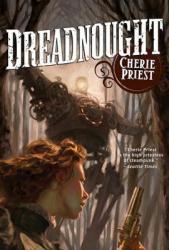
Reviewer's Name: BenjaminFor the most part, the book series I have read progress the story from one book to another. I get that there are some series with the same character in different predicaments for each book, but jumping from one character to another in each different book is an interesting tactic. Of course, I’m somewhat guilty of this, as The Fluxion Trilogy focuses on different characters for each book. As far as I can tell, The Clockwork Century series also does this, even if the connections between the characters are flimsy at best. Even so, the plot seemed to take a step backward from Boneshaker to Dreadnought.
One of my qualms with Boneshaker was that there wasn’t a lot of world-building that established what this alternate-reality Seattle was like in the scheme of the broader United States. Dreadnought solves this problem by giving the main character an opportunity to travel across the country, thus establishing some of the world-building in the process. In fact, there were a few points where I wondered if I had picked up the first book in the series, only to confirm that Dreadnought was the second book. Unfortunately, I thought the plot of Boneshaker was a little more believable since the cross-country trek in Dreadnought seemed like an obvious ploy by the author to introduce the world to the reader.
I certainly appreciated the thinking that went into the consequences of a decades-long Civil War, but I still think the “zombie” angle of this series seems out of place. I get that steampunk is the combination of some more modern technologies in a Victorian era, but the zombie genre seems so modern that combining the two never really gelled for me. Plus, through the plots of two books, I feel like I’m no closer to understanding where the gas that creates the zombies originates, or if there’s even an endgame to the zombie situation.
A book that should have come first in the series, I give Dreadnought 3.5 stars out of 5.
Genres:
Review:
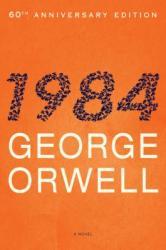
Reviewer's Name: Joe T.Although the year 1984 has long since passed, the reality created in Orwell’s novel 1984 contain aspects that our society is beginning to show. 1984 follows a society where the world is ruled by 3 superstates: Oceania, Eastasia, and Eurasia, each of which have a totalitarian english socialism government. The government of Oceania has surveillance on every citizen through monitors called telescreens that enable them to hear and see what every person is doing and every citizen is required to have a telescreen in
their homes. This enables them to see if the citizens are committing “thoughtcrime” and if they are, the thought police kidnap the person and erase them from existence. Winston Smith is our main character with a quiet rebellion against the totalitarian government of Oceania. He believes that he is an individual and should be allowed to have his own freedom. As Winston tries to avoid being erased from existence and maintain a romance with the love of his life Julia, the government slowly closes in on his treason. This is one of my favorite novels and a masterpiece by Orwell as it shows how a society with a controlling government creates fear and false order for the citizens. Aspects within the novel are present in our own government today, so who is to Orwell’s predictions aren’t slowly but truly becoming a reality.
Awards:
Genres:
Review:
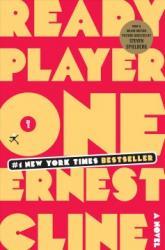
Reviewer's Name: Isabella W. I don’t know where to start with this review because there are a lot of different elements of the novel to discuss. The reason why I rate Ready Player One four out of five stars instead of five out of five is the overwhelming amount of 80's references mentioned in literally every line that honestly only further bored the audience. The references to Star Wars, Indiana Jones, Back to the Future, Dungeons & Dragons and more were tolerable because they were iconic - something an individual born 20 years later still understands. Then, Cline writes paragraphs on Atari consoles and Black Tiger or Joust games which just isn’t relate-able for the majority of the audience the novel is targeting (which is why I assume the director replaced the Joust scene with a car race in the movie). But the dominant issue with Cline’s writing is not even necessarily the amount of references but the fact that he explains every single one. At some points, I thought about how I might’ve read a Wikipedia article for the same informational effect. There are plenty of plot twists to contribute to a surprising manner regarding both the characters and the video game - I was never bored with the plot. Ready Player One is one of the many futuristic dystopian sci-fi novels everyone in this generation reads - which is why the 80's references bothered me. I don’t think this is the type of novel most adults born in the 60's or 70's are going to read, yet Cline tries to appeal to them anyway.
Reviewer Grade: 11
Awards:
Genres:
Review:
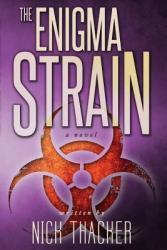
Reviewer's Name: Benjamin M. WeilertThe basic formula for a thriller is as follows: one loner, one love-interest, and lots of running. The Enigma Strain is your cookie-cutter thriller, which isn’t necessarily a bad thing. The premise is somewhat entertaining, if not downright ridiculous and unrealistic. The pacing is certainly fast enough to keep the characters moving and racing against the clock of destruction (at times even literally). In the end, there were no surprises as the day is saved and the loner opens up enough to attract the love interest. The fact that the ending was predictable just meant that it delivered on the thriller formula.
One of the weaknesses of The Enigma Strain is the sense of space and time. There was plenty of driving around to different locations, which made them seem like they were quite close together. However, the love-interest kept talking about flying, which made me wonder how far away these places were. If it took a long time to drive between them, there was a lot of time these two characters were in the car together that wasn’t necessarily alluded to. I know I can get irritable after a long time in the car, and the fact these two strangers weren’t at each other’s throats after a collective eight hours (or more) of driving felt strange.
While The Enigma Strain had all the trappings and accouterments of a standard thriller, it also contained many of the “wait, why?” faults that separate a lot of thrillers from actual reality. Some of these questions were answered (like why the main character is a loner), but others were frequently touched upon but never fully explained (like why the main character is afraid of flying). In the end, if you want a fun escape from reality, a good thriller like The Enigma Strain can probably fit that bill.
A standard thriller that follows the thriller formula, I give The Enigma Strain 3.0 stars out of 5.
Genres:
Review:
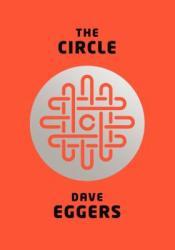
Reviewer's Name: BenjaminWhen I saw the movie adaptation of this book, I felt like the presentation of this somewhat interesting idea was already dated by about five years. This made me curious if the book was any better. As is probably no surprise to anyone, the book was much better. Sure, the movie cut a few things from the book that I thought were a bit too unnecessary (all the “sex,” that is) or underutilized (the “Calvin” character), but the book really hits at the intensity of the internet-addicted generation. I would even go so far as to say The Circle is the modern version of 1984 .
I’m somewhat torn when it comes to the message presented here. I understand how trying to stay on top of millions of e-mails, and thousands of social media updates can be utterly overwhelming. I also agree that a lot of ideas that seem to be beneficial to society will have the removal of personal privacy as an adverse side effect. However, the vehemence that people participate in the world does bring up a good point about apathy. Granted, I don’t think we should be nearly as extreme in our “oversharing” on social media, but if the majority of success is just showing up, then why do so many people find themselves too busy to even participate? Do they not want to engage with their fellow humans?
I did appreciate how the transition from utopia to dystopia went almost entirely unchecked. The main character’s journey really helped to show how the addicting nature of online interactions and instant feedback can get out of hand. From documenting our lives to searching for information to even searching for love (of which internet dating wasn’t included in the movie), the internet is a powerful place. If anything The Circle highlights how dangerous a true democracy can really be, particularly if the minority opinions are known at each decision point.
A terrifying look into our digital mirror, I give The Circle 4.5 stars out of 5.
Awards:
Genres:
Review:
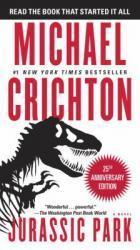
Reviewer's Name: Peter C. One of the most classic science fiction novels ever written, Jurassic Park is a tense, action filled, and groundbreaking book that won't let you go! The novel takes place on a tropical island, where a man has invented a technique to extract dinosaur DNA from mosquitoes, and is then able to breed living dinosaurs. However, something goes terribly wrong, and the characters then have to escape the island with giant dinosaurs after them. The novel is incredible, and it displays the dinosaurs perfectly. The characters are all fleshed out and seem like real people, and the couple sub-plots are exciting and do not seem tedious at all. I would recommend this book to anyone looking for an action story, a sci-fi novel, or a good book in general.
Genres:
Review:
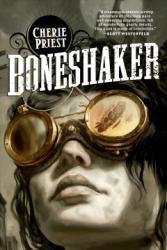
Reviewer's Name: Benjamin M. WeilertI suppose when I chose to read this book, it would have been a little more steampunk than it was. Sure, Boneshaker has some of the trappings of a steampunk story, like the Civil War and inventions comprised of brass; but in the end, it felt more like light window dressing than something important to the plot. Surprisingly enough, this book was more along the lines of a zombie apocalypse novel than a steampunk one. In that sense, I’m disappointed that the cover didn’t completely deliver on its premise and instead decided to rely on the tropes of the post-apocalyptic genre.
The characters themselves were somewhat interesting, but their motivations seemed a little flat. The boy who wants to find his father and the mother who chases after him aren’t that compelling. In fact, the journey of both characters could have probably been accomplished via one of them, with supporting characters providing information about the other one. If anything, the plot was only used as a method to explore this semi-steampunk Seattle. This meant that, by the end of the book, there were quite a few more questions I had than answers. I guess that’s why there are two more books in this series.
I think my main problem with this book is that it isn’t more thoroughly tied to real history and real locations. Sure, there were a few mentions of the Civil War, but if you removed those few links to history, the story stands on its own pretty well. In fact, you could probably set this anywhere, even in its own, unique world, and it should still work. Because it doesn’t rely on our knowledge of history and familiar places, it doesn’t feel like the “alternate history” that steampunk can provide. In the end, this was a pretty good idea, but it’s misleading in its marketing.
A post-apocalyptic zombie book that has hints of steampunk thrown in, I give Boneshaker 3.0 stars out of 5.
Awards:
Genres:
Review:
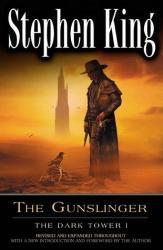
Reviewer's Name: Peter CWhile Lord of the Rings and The Hobbit have had their moments as fantasy epics, I believe that The Gunslinger, and indeed, the whole series, deserves to be placed right next to Tolkien's masterpieces as one of the greatest fantasy books/series of all time. Taking place in a medieval world that is somewhat similar to the Old West, but exists in a parallel time frame to our own, we follow the journey of Roland of Gilead as he travels across this universe in search of the nexus of the universe--The Dark Tower. The novel is filled with adventure, intrigue, suspense, humor, and action that keeps you reading, no matter what. While not a traditional horror novel like King is known for, it is still a worthy addition to the King collection. I would recommend this book to anyone looking for a great fantasy book series to read, or any Stephen King fan.
Genres:
Review:
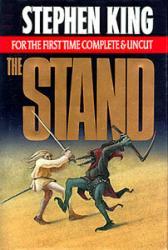
Reviewer's Name: Peter CAfter a super virus wipes out almost 90% of the entire global population, only a handful of survivors remain. That is where The Stand takes place; an America devoid of almost all human life, as the survivors attempt to rebuild their society, all while battling the sadistic Walkin' Dude who is out to destroy them. The novel is long, epic, and deep. It is, however, over 1,000 pages; however, give it time, and you will truly enjoy this journey. I would recommend this book to fans of epics like Lord of the Rings, Stephen King fans, or anyone looking for a good read.
Awards:
Genres:
Review:
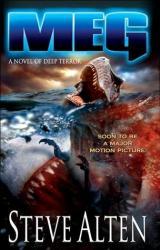
Reviewer's Name: Peter CWhile Jaws may have terrified readers with it's suspense, Meg follows in Peter Benchley's footsteps for only a few steps-and then veers off in a completely different direction. This is a novel all about a small group of scientists trying to kill a gigantic megalodon shark after it escapes from it's hovel in the Marianas Trench. It also has a pinch of scientific mumbo-jumbo and horror to draw all sorts of different readers and to keep you hooked. The characters are diverse, likable, and fleshed-out, and the main antagonist, the 60 foot long megalodon shark, is so entertaining to read about. I would recommend this book to anyone who enjoys action, suspense, or sharks!
Awards:
Genres:
Review:
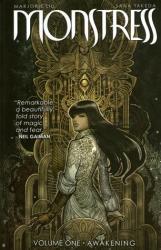
Reviewer's Name: Mona HI chose this book because comics are a type of novel that I find interest in. This is a fantasy book that takes place where monsters and humans are divided after a war, and monsters who are caught by humans on the other side are used to be sold and experimented on. The main character, Maika, goes on the other side in search for hope of her mother. This is highly recommended for anyone who enjoys comics.
Genres:
Review:
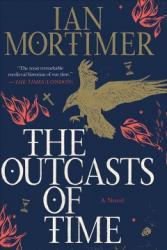
Reviewer's Name: Tawnie M.This book follows the story of two brothers John and William in 1340’s Medieval England who are suffering from the Black Death. But as their end draws near, they are given a choice that changes the course of their lives forever. They are told that they have six days left to live, which they can either spend with their loved ones, or search for salvation and redemption for their lives across the centuries; spending each one of their remaining days 99 years after the last. So, each day takes places one century after the last. The brothers choose the latter and are launched into an adventure that spans centuries in the time frame of a few days.
Observers of the world across centuries, John and William hardly recognize the world around them each day they wake up, and as their journey for salvation progresses, questions the world around them in a way that has readers questioning humanities true motives. Rather than focusing on the good things and advancements the world has made through the centuries, the characters, especially John, ponder how these advancements have brought humanity farther and farther away from God. As the years and days progress, the novel asks the question what is true salvation really and examines the idea of what is good verses bad?
When I received an ARC of this book in the mail from the publisher at first, I wasn’t exactly sure what to make of it, but as I read the back, I became excited, because this book deals with a sci-fi like subject of time travel in a way I haven’t seen before. This book took me a while to get through and it also is a book that really makes you think. Warning! If you are looking for only a traditional time travel sci-fi book, this book is probably not for you however, if you like historical fiction this book is probably more for you. This book deals with time travel in a highly conceptual way. It is a time travel book written by a very noted historian and reads very much like a historical novel with all the historical details you would find in a history book. But it is also very philosophical as the main character questions the world and the ideas in it. As this quote from John shows when he is discussing, with the family he is staying with, the bad things done by others around them.
“I myself wish for nothing more than to spend the rest of my days engaged in good deeds,’ I say. But how can I tell what a good deed is in this day and age? What is “good” and “bad” if God’s law is constantly changing? How can we do good if the meaning of “good” and “bad” are dependent on who wins the war? How can a man go through this world in sure knowledge that he is doing the right and proper thing?”
This is just one of many philosophical musings that the author poses through the book that seek to answer difficult questions and these details really make the reader think and ponder the difficult answers to questions like, what is good verses bad. These details I think also give the book a conceptual quality that puts it above the norm and makes it more than just another sci-fi book about time travel.
Ian Mortimer is an excellent historian and the historical detail in this book are incredible! He weaves together history and time travel in a highly original and interesting way that makes readers both question the world and presents readers with a clear picture of England’s evolution from a small underdeveloped town to a large industrial country that leads the world in more ways than one. I highly recommend this book for readers of historical fiction or anyone who likes highly conceptual, philosophical books that question the world and everything in it. I give this book a solid 5 out of 5 stars!
Thank you to the publisher Pegasus Books for an ARC of this book for review.
Genres:
Review:
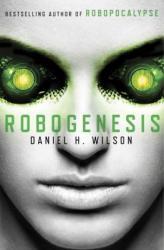
Reviewer's Name: Benjamin M. WeilertWhile I appreciated the logical nature that Daniel H. Wilson brought to the idea of a robot apocalypse in Robopocalypse, I felt the book itself was disjointed as a series of short stories that examined the various forms our robot servants would turn on us. The whole book seemed more like an academic exercise than a piece of fiction. In the follow-up to Robopocalypse, Wilson picks up right where the last book left off. With the exposition of how the robots turned on us already covered, he then is able to fully explore the fictional environment via its characters in Robogenesis.
It took me a little while to recall who some of these characters were and what had happened during the previous book, which left me confused in the early moments of each section. Once I eventually got my bearings, the stories themselves were interesting and tied together pretty well. Some of the action was a little disorienting, but overall I had a good idea what was happening. There were a few storylines I would have liked to see fleshed out more (like Matilda’s storyline), as well as some that were perhaps fleshed out too much.
And by “fleshed out,” I’m of course referring to the almost gratuitous and graphic violence that’s present in this book. I’m not sure it was really necessary, and it was more unsettling than anything else. I mean, I get that the end of the world will be violent, but it doesn’t need to be described in gory detail. At least by the end of the book, it looks like there’s a satisfying conclusion, but with the clear indication that the war is not over. This means I’ll probably have to read the next book in this series whenever it comes out.
A good sci-fi that blends realism with a few entertaining characters, I give Robogenesis 3.5 stars out of 5.
Genres:
Review:
Reviewer's Name: Mary Grace C.The only reason I read this book was because of the movie starring Emma Watson and Tom Hanks but I'm one of those who [for the most part] read the book first before watching the movie because we all know that books are always better and have more details than the movie versions.
I've been on the fence about deactivating my Facebook and Twitter accounts and signing up for Instagram or keeping my blog, Ravelry and GoodReads active since I use Ravelry and GoodReads mainly as online databases for my yarn craft and books respectively so I won't have to create an offline database from scratch and my blog as a way to share things that I enjoy and my book reviews like this one. The Circle by Dave Eggers definitely showed some pros and cons to going "off the grid" to quote Mercer and some pros and cons to being online to keep up with family and friends and social media is good way to reconnect with old friends especially if you have no way of contacting them because your address book hasn't been updated in a long while.
Enter Mae Holland who hasn't used her social media account in a while and ends up working for the Circle, a tech company who is all about sharing [everything] and being social online and offline and unifying everything into one account. I rated this book 4 stars not because it's really good but mostly because the author managed to make me feel something and made me think. When Mae first started working at the Circle, I felt as stressed out and exhausted as Mae felt while learning about her new job and balancing her work-related duties as well as her "social" duties and the constant need to "smile," "frown," and "zing" can be overwhelming for someone like me who likes to moderately share things online. Yes, I do believe that there are things that should be kept private and still do even after reading this book.
I don't think it is healthy to spend so much time online "smiling," "frowning," and "zing-ing" what other people share to the point where you no longer have time to live your life in the real world. And changing your opinions because you don't like getting "frowns" is not being human. Being human is about having different opinions and thoughts and it shouldn't matter if your opinion is unpopular because it is you. The way it is presented in this book is that slowly, everyone in the world is of one mind, one opinion which is already happening in the real world. People get shamed, hated on or bullied online when you express sentiments that are not in line with the sentiments of others. And this mentality should stop.
There are some aspects of unifying databases from this book that I liked the idea of. An example would be medical records that way when you switch medical providers or during medical emergency situations, all your records can be found in one centralized system/location to make it super efficient for the medical team to give you the right medication or treatment as well as if you're unconscious, there's a way to alert your medical/care team to send help. While it is also great to get real time results on polls and surveys, being forced to vote by suspending all electronic/computer/online activities until you've voted is wrong in the sense that people have the right to vote or not vote. Sure it will help a lot if everyone voted but to make it mandatory like what the Circle suggests violates the right to decide whether to vote or not. I'm on the fence about humans getting micro-chipped like most of our pets are micro-chipped because I personally don't want everybody in the world to know where I am. I only want my I.C.E. (In Case of Emergency) contacts to know where I am and that's about it. There's more examples in this book that I'm either on the fence on or completely against the idea of but I have to end it here otherwise, this review will be as lengthy as the novel itself.
Moving on to the general overview of the plot. It's believable to some degree and I can see the parallels to the real world especially on the social media aspect and we are somewhat slowly getting there on the other technological aspects. The pacing of the story is slow to moderate and sometimes it makes you think if there's any point to this whole thing. The whole time I was listening to this book, I was waiting for a really cool plot twist or a big revelation or a big self-discovery, but unfortunately, none of those happened. There was a revelation towards the end but it was a bit of a let down because somehow, at the back of my mind, I already knew that.
As for the characters, I feel like they're not as well-developed as I'd hoped. There's no real depth to Annie, Dan, Jared, the three wise men, Francis, or any of the rest of the characters, including Mae (more on that, later). It feels like these other characters are there to either add drama in the case of Francis, to move the story along in the case of Dan, Jared, the three wise men, etc., and as proof of validation and someone to vent to as in the case of Annie. As for Mae, I somewhat resonated with her in the beginning but as the book progresses, her character became less real and more fake in the sense that the Mae readers liked in the beginning slowly disappeared as she became "one with the hive" err Circle and lost her own individuality. Another thing that was disturbing about Mae was in the end, while visiting her catatonic best friend, Annie, she looks at one of the monitors scanning Annie's brain waves and wonders what Annie's dreaming/thinking about while in a coma and decides that people's thoughts should be accessible to everyone and that "the world deserves nothing less" which to me, is frankly, quite disturbing.
Finally, the narration. Dion Graham did a wonderful job narrating/reading this book even though this book follows Mae's perspective and there's none of that high-pitched voice trying to sound like a woman/girl.
In conclusion, if you are someone who shares everything online then you might enjoy this book and if you are someone who is on the verge of deactivating all of your online and social media accounts, you might find extra reasons in this book to permanently go offline. If you are someone who likes to see characters evolve into a better version of themselves, this book is not for you.
Awards:
Genres:

Review:
Reviewer's Name: Isabella W. 1984, written by renowned author George Orwell, a pseudonym for Eric Arthur Blair, follows the protagonist Winston Smith set in what Smith believes to be the 80s in London. In fact, Smith is not sure of anything anymore, definitely not the exact year or what happened to his family or who the mysterious dictator called Big Brother is or who his state is at war with. Eurasia, right? No, must’ve been Eastasia... All Smith knows are the mottos of each of the ministries that form the government in Oceania, where London is. WAR IS PEACE. FREEDOM IS SLAVERY. IGNORANCE IS STRENGTH. He is told what to think, what to say, and what to do for nearly every part of his life. His government banks on strict organization and dire consequences for disobeying the rules. 1984 is an interesting read that set the bar for dystopian novels, defining inefficient governments from real life examples.
The novel is more realistic being inspired by Orwell’s hatred for totalitarianism and the events of World War II. I recommend 1984 to anyone curious about examining different types of societies, their standards and how those effect the population. The novel is fairly political and examines rebellion, although not as face paced as typical young adult reads. 1984 allows for an in depth examination of the character’s internal conflicts, Winston is one of the more detailed and complex protagonists because there are many parts where he cannot he sympathized with due to his lesser characteristics. The setting is clearly presented in a more world-building way than just giving out straight information. I was especially pleased, surprised, curious, and angry throughout the progression of the story.
Overall, I did enjoy this book more than most others, but the fact that Winston does not form any significant relationships until the second part and is the primary person talking, I was relatively bored during the middle chapters.
Reviewer Grade: 11
Awards:
Genres:
Review:
Reviewer's Name: Joe T.Among one of the first Dystopian genre novels ever published, Aldous Huxley’s Brave New World questions the extent at which technology could potentially control society. Set approximately 632 years after the creation of the Model - T, a World State now controls society with the intent on eradicating personal thinking and individual creativity. With a new system called the Bokanovsky process, the World State utilizes the idea of Henry Ford’s assembly line to produce thousands of nearly identical embryos that will grow up to work for the State. All embryos are conditioned to be in one of the 5 castes: Alpha, Beta, Gamma, Delta, Epsilon; with Alphas destined to control the World State and Epsilons to perform menial labor. When Bernard Marx, Helmholtz Watson, and John decide that something is wrong within this “perfect” society, they take it into their own hands to expose the World State and stop this flawed Utopia. Huxley’s novel, written in only 4 months, is phenomenal because it challenges the ideals of the limits to which technology can override nature. With the novel being published in 1932, Huxley questions practices that were uncommon and unrealistic back then, but are slowly becoming a reality now as our society leans more and more towards technological innovations. I recommend this novel to high school readers, especially those interested in the Dystopian genre, since this is a perfect example of a Dystopian Utopia.
Reviewer Grade: 11
Awards:
Genres:
Review:
Reviewer's Name: Jordan T. The Hitchhiker’s Guide to the Galaxy by Douglas Adams is witty, genius, and an example of common English humor: dry, but hilarious.
Seconds before Earth is blown away to make way for an intergalactic freeway, Arthur Dent discovers galaxies and planets, lightyears beyond his own. He hitches a ride with his best friend, Ford Perfect. Ford is a cleverly disguised alien, who has been stranded on Earth for the past 15 years as he writes a revised guide to the galaxy. Arthur and Ford happen to hitch ride with the most disagreeable and intolerable creatures, the Vogon. They are then discovered and thrown into the soul-sucking abyss of space. Seconds before they suffocate, Ford and Arthur are picked up by a recently stolen ship, stolen by the president of the galaxy, Zaphod Beeblebrox, and his girlfriend, Trillian. The ship is on an improbability drive, which is why they crash land on a long believed mythical planet, called the Heart of Gold.
The planet was in a hibernation-like state, and has only just awoken recently. Trillian, Ford, and Zaphod explore while Arthur meets Slartibartfast, who explains that the Earth was a test, run by mice, to discovery the Question of Life, since they know the answer is 42. However, Earth was destroyed seconds before test completion. Trillian, Zaphod, and Ford are captured by the mice and kept in a dream-like prison. That is, until Arthur is brought to the mice and the group is reunited. The mice explain that they are interested in harvesting Arthur’s brain as organic evidence.
So, naturally, the group manages to escape in the knick of time, avoiding both the mice and the galaxy police, who are searching for Zaphod.
Reviewer Grade: 7
Awards:
Genres:
Review:
Reviewer's Name: Tawnie M.When I picked up this book, I have to admit, I was surprised, because sci fy steam punk fantasy stories is not the type of book I usually read, yet it ended up being so much more than I had imagined. The Clockwork Dynasty is not just a book about a race of humanlike mechanical creatures or avtomats that secretly live among us and are fighting a war that has raged for centuries, but it’s a story about life and the constant search for meaning and purpose.
This book waffles back and forth between present day Orgon, Washington and other places, and the 1700’s beginning in Russia and taking the reader on a journey through history and time. And while this may bother some people, the non-linear storytelling I think, adds so much more to the book and allows the author to unfold the story in a deeper more meaningful way.
In present time it follows the story of June someone who has made a career in ancient technology, ever since an encounter she had a child with her grandpa changed her perception of the world and started her fascination with this avtomat technology. A couple years after her grandfather’s death she receives a avtomat artifact that will cause her to team up with an avtomat named Peter, launch her into a great adventure in the secret avtomat
world, and ultimately determine this race’s extinction or survival. In
the 1700’s it follows the story of brother (Peter) and sister (Elena) two humanlike avtomats that were resurrected by a Russian clock maker using something called an anime which serves as the Avtomat’s heart and soul. As they live through the years they spend it hiding their secret, trying to blend into society, and fighting a war that has been raging among their own race for centuries.
This story explores the character’s constant search for meaning in a way that is both at times sad and extremely insightful. In the book each avtomat’s anime is marked with a Pravda or a special word that is their bond and command. As long as they satisfy their Pravda, they are at peace, otherwise they suffer. In Peter’s case this word is justice. As the book progresses we see his idea of justice shift and change as he lives through the years. Through a fascinating inner dialogue, Peter perception shifts from gaining justice simply by serving rulers in war to something far deeper and more moving, as this quote, when he encounters a dying soldier on the enemy’s side in the battlefield, suggests:
“Once Pravda was clear to me. By obeying my emperor all was well. But what was simple is becoming complex. I can see no evil inside this grievously wounded man, only honor. And though no clockwork flutters beneath his throat, I can see the inevitable forces that led him here, through no fault of his own, fating him to die in the shadow of this crumbling wall.”
As the book progresses a new perspective of right and wrong emerges leaving him questioning not only who he is but why he was made.
Another major theme this story also explores is the theme of war. As Peter recounts from his past, countless experiences on various battlefields throughout his life, and in the present, his own thoughts on his own race’s war; the reality of war is pressed heavy on the reader making this book at times very depressing, sad, and dark.
This reality is made even more real by the moving prose and incredible worldbuilding that takes place throughout the book. Another reason I love this book is the incredible character development between Peter and Elena.
How she is treated by him as a little sister at the beginning of the book, and how he sees her changes through the book from a little girl needing his protection to a sophisticated, wise learned, woman who’s one desire is to make her own way in the world is absolutely incredible. Daniel H Wilson does an amazing job of weaving together past and present into an engaging literary story that has something for everyone. Thank you to Doubleday books and Netgalley for an e- ARC in exchange for an honest review!
Awards:
Genres:
Review:
Reviewer's Name: Jordan T.Kathy isn’t a normal kid, and neither are any of her friends. They were all cloned, and someday, their vital organs will be harvested until they die. But for now, they will grow up in a secluded boarding school nestled in a corner of England, called Hailshem. Hailshem is idyllic: creativity is nurtured, friends are everywhere, and there are supported teachers. Kathy retells her experiences as she looks back on her life in preparation for her organ donations. And…. that’s basically it. It sounds like a really interesting concept for a book, but the author completely butchered it! His writing drags on and on, and completely bored me to death. If he had written it better, or if someone rewrites it, the book would be fascinating. But the writing style is so dreadfully dull. I warn you-- do not read this book! You will seriously regret it if you do!
Reviewer Grade: 7
Genres:
Review:
Reviewer's Name: Monique BakerWhat happened to the last expedition? Was the last expedition male? Where are the male of the local species? Is Jael the only male in the area? Has he created his own harem of native women, driving off the males with his pheromones?
I found this book on a must read list from NPR for 2017. It looked interesting and had a fascinating synopsis and review. I read it, liked the drawings and wanted to know who “Jael” was from the story. The last interaction between the women is about his criminal history. Aphra asks Sarai what it says and she responds with “It doesn’t matter.” However, I suspect it does, I think it had a direct impact on everything that occurred in the story. The author did a good job of “setting the hook” with that closure. Considering the dream fish sequence, I think it was intentional. As I reread the story a few more times, elements that seemed trivial began to come together and illuminate more of the story. I think it is worth a read, or several reads.
Genres:
Review:
Reviewer's Name: BenjaminMost people know this book by its numerous film adaptations, including Invasion of the Body Snatchers (1956 and 1978), Body Snatchers (1993), and The Invasion (2007). In fact, I like to think that many facets of this story have become a part of popular culture, including the replication “pods” and Donald Sutherland’s scream in the 1978 film version. While the source material is inherently pulpy, a result of the genre and the era in which it was published, there is an entertaining quality to the story that has allowed it to survive for so long.
Simple in its execution, but brilliant in its reveal, The Body Snatchers builds up an inherent distrust of the people surrounding the main characters as they investigate why everyone seems “off” in this small, California town. While the full explanation of the aliens’ presence and purpose is relegated to an enormous information dump more than half-way through the book, it nevertheless contains some interesting ideas and concepts that could be plausible given the circumstances. I would have preferred better integration of this information into the plot, but sometimes the characters just need to sit down and explore these ideas in depth.
In the end, The Body Snatchers has plenty of strong moments in its plot. Sure, there’s the weaker section or two, and the more upbeat ending didn’t have much explanation other than the aliens’ annoyance of humanity’s persistence. Still, it’s a fun story, and even decades later it’s clear why The Body Snatchers is a timeless classic, even if it’s not “on par” with more significant literary titans. Maybe that’s its charm, though. By making it about the “everyman,” the horror and terror of everyone around them being replaced by emotionless beings is much more relatable on a visceral level.
A timeless pulp classic, I give The Body Snatchers 4.0 stars out of 5.
Genres:
Review:
Reviewer's Name: Christopher K. How Few Remain is a alternate history novel by Harry Turtledove. In his book, it depicts an alternate universe where the south wins the American Civil War, and the Confederate States of America is now its own independent country. What I enjoyed about this novel is the many different characters and how they view the other country. In every page you can just see the tension that will eventually snap between the two powers. People from the North and the South always spewing insults at each other. Each character that comes into play are very interesting and all seem like they have their own backstory. My favorite character in the story would be Abraham Lincoln. Just because you get to see what his life is like and how the country views the man who lost the civil war. The book is also just the first part of a series which goes through the period of World War I and World War II and how the North and South react to that. I believe there are two things that make this book standout, its characters, and its lore. For those two reasons alone I will have to recommend this book. Or the entire series, what ever is your cup of tea.
Genres:
Review:
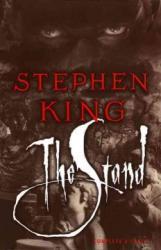
Reviewer's Name: Tabitha V.The book "The Stand" by Stephen King is a novel about a disease. It starts out at a gas station where the disease is first seen in the novel. This book has many different characters as it progresses. The main antagonist is the embodiment of evil. He is basically the Antichrist. Although I didn't like this book as much as some of Stephen's other works because I have a short attention span and some parts are not attention grabbing. It is still a very good book and I would definitely recommend it to anyone who likes horror. This novel is very unpredictable which is one of the main reasons I like it as much as I do. Because there are so many characters in this book, it was very easy for me to relate to their situations.
Reviewer Grade: 9
Awards:
Genres:
Review:
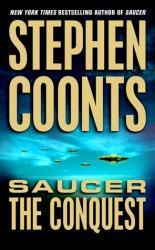
Reviewer's Name: Elijah A.In this Sci-Fi thriller sequel to the first Saucer book in the series, Stephen Coonts brings back ex-air force test pilot Charley Pine, Rip Cantrell, and some new key characters. Charley Pine is hired to fly a french spaceplane to the moon, where she finds a french Millionare by the name of Pierre Artois. Charley soon finds out what Artois and his conniving wife Julie are actually up to. A massive Anti-Gravity gun is stationed on the moon, Pierre and his wife have been planning for years for their ruler ship over the earth. All the while this is going on, Rip's uncle, saucer expert, Egg Cantrell is kidnapped by mad scientist Newton Chadwick and is forced fly him to the moon in another saucer... Rip Cantrell and Ms. Pine find out about this and steal another saucer from a Smithsonian. Soon a fierce battle in outer space takes place. Who will come out on top? This sequel to the first Saucer book should definitely be on everyone's radar. Young or old, this book will leave you all wanting more more every page you turn over!
9th Grade Review
Genres:
Review:
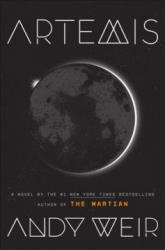
Reviewer's Name: Benjamin M. WeilertAfter reading Weir’s breakout work, The Martian , I looked forward to his next novel, Artemis, with rapt anticipation. The scientist in me appreciated how Weir made a realistic setting with realistic science an approachable and entertaining endeavor. The writer in me liked how he kept the tension throughout the plot of The Martian at a consistent level. Consequently, I had high hopes for Artemis and wondered if he could outdo himself (or at least match his previous success) considering how highly regarded The Martian ended up being for him.
Between the two books, Weir seems to have created a style that consists of three elements: accurate science, event-driven plot, and a racially diverse cast of characters. In Artemis, we now find ourselves on the moon, where a colony has been created and sustained for a few decades. Weir conveys the science involved with such a feat naturally and realistically. The exploration of this science is usually through the string of “oh shoot”
events that occur throughout the plot. Finally, with an Arab woman as the main protagonist of the story, supported by a Kenyan man, Ukranian scientist, and her father.
Despite these three elements creating an exciting story, the impact of Artemis felt less than that of The Martian. In The Martian, the driving force of the plot is the survival from isolation. Artemis has a different survival:
avoiding homelessness. Additionally, while Mark Watney was a scientist and astronaut who could “science his way” out of his predicament, Jasmine was a little more “working class” who seemed to jury rig stuff together just because that’s the only way she knew how. Of course, being more “working class,” the profanity seemed a lot more prevalent in Jasmine’s speech than in Mark’s. Both books had profanity; it just seemed like Artemis overdid it.
An Andy Weir book that doesn’t quite live up to The Martian, I give Artemis 4.0 stars out of 5.
Awards:
Genres:
Review:
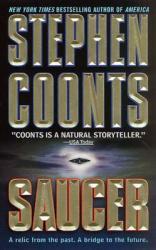
Reviewer's Name: Elijah A.Saucer is an amazing Sci-Fi, Adventure, Thriller, and suspense book.
Stephen Coonts is a very talented Author who uses very good word choice. This is quite evident in his Saucer Trilogy, he seems to use the best wording at the best possible time. This book is definitely a great choice for all 13+ year old Audiences. Young Rip Cantrell is put under difficult circumstances numerous times. When his life and the life of Ex-Air Force Test Pilot Charlie Pine, and his grandfather are at stake, he makes a choice that will change his life from that point on. This Novel brings not only the thrill of life and death so many times, but amazing science fiction story line for us Sci Fi geeks. Obviously this book involves a saucer, Hence the name "Saucer", and this saucer appears to be lodged in that sandstone for over 140,000 years.
Now this saucer isn't made from man, as proven when Rip and his companions explore the object after days of digging it out. Over the course of this book, action escalates quickly, as Rip ends up across the world in Australia trying to save Charlie from the 2nd richest man in the world... Saucer is a stunning, action filled, adventurous book, at what might have been and what be. Go check this book out for yourself! I guarantee you will not be disappointed!
Genres:
Review:
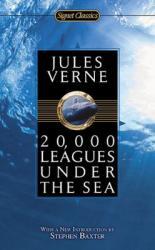
Reviewer's Name: Elijah A.They're attacking our vessel Captain! Those savages want to kill us!", "Leave me Conciel! Save yourself my friend!". No doubt these few short phrases from the amazing novel strikes great interest in your mind. 20,000 leagues under the sea is an Adventure Fiction novel written by Jules Verne, and is by far 1 of the best books I have ever read. Professor Aronnax and his faithful servant Consiel board american frigate Abraham Lincoln to embark on a long journey back to France. On the way though, they spot a creature, a monster unlike anyone has ever seen up until that point. After a fierce battle with that monster Pierre Aronnax, Consiel, and a Canadian Harpooner are thrown overboard their frigate lost in the middle of the Vast Atlantic.
Later refuge is found aboard a metal island... Wait? Metal Island? In the middle of the atlantic? Something isn't right. Alast Captain Nemo and his crew surface the mighty vessel and capture Aronnax and his companions.
Sometime later Pierre and his companions alike, awake in a small, pitch black room, not knowing what had happened, or what is about to. Want to find out what happens next? Well go and find this book for yourself! Getting stuck underneath an iceberg in the antarctic! Battling 1 of earths mightiest creatures! Experience the great suspense, action, and adventure this novel brings to you!
Reviewer: 9th Grade
Genres: